Successional Accumulation - a syntropic strategy by Scott Hall

When syntropic agriculture arrived in Europe, it took on a very specific form, codified around a course that Ernst Götsch taught in São Paulo, Brazil, about a decade ago. Speaking to an audience of non-specialists, Ernst showed how one could plant all the stages of ecological succession from the very start, in a single row holding plants meant to populate the system's various layers (emergent, high, medium, and so on) over the short, medium and long term.
Lately I've been paying close attention to the excellent work of Scott Hall — mostly on his paid platform, Syntropia, but also in what he shares on YouTube and social media. Scott has developed a syntropic approach that mimics natural processes more closely; and in nature, clearly, ecological succession doesn't unfold "all at once" but in stages — in his words, through successional accumulation. He's the first to point out that he hasn't invented anything: this is syntropic agriculture, much as Ernst and various farmers in the north of Brazil practise it, and as you can read in Götsch's early writings. He has simply taken a fluid application of those principles and put it into a form that can be shared.
I'll try to sum it up here, weaving it together with my own way of reading succession and with a few observations made in Mediterranean and temperate climates. With no claim to being exhaustive.

1. Ecological succession
It helps to be clear about the process everything rests on. I wrote about it more fully in an introduction to syntropic agriculture some time ago, so here I'll keep it to a brief reminder. In nature, degraded soil doesn't stay bare for long: it gets colonised in phases, and each phase prepares the ground for the next.
Colonisation. First come the microbes and the pioneer herbaceous plants — ephemerals, annuals, then perennials — able to live in extreme conditions. They draw up minerals from deep down, fix nitrogen, add organic matter. In syntropic jargon, this is the system's placenta.
Accumulation. Pioneer shrubs and trees take over from the herbaceous plants. With the lignin in their tissues they encourage humification, cast shade and send down deep roots, and make the soil more hospitable. What accumulates is natural capital: biodiversity, complexity, fertility — in a word, syntropy, the opposite of entropy.
Abundance. This is the mature phase: plants in every layer (low, medium, high, emergent) and with different life cycles, fruit, nut and timber trees, a rich fauna. The thread running through every phase is a single one: soil fertility.
Three things are worth keeping in mind here, because they come back throughout: succession proceeds in phases; each phase creates the conditions for the next; no phase skips its turn.
2. The limits of "plant all at once"
Putting species from every stage in the ground at the same time has a cost. If I plant an abundance-phase species into soil that's still in colonisation, I'm placing it outside its successional niche; to keep it alive I have to supply everything that niche doesn't yet offer — compost, mulch, fertilisers, water, foliar feeds. For the most part you end up doing gardening rather than syntropic farming — what Scott aptly calls a "plant hospital". And as with people, staying healthy outside hospital tends to cost less than staying inside one.
There's a second, subtler point: people often put in plenty of diversity and too little density per stage. It's a mistake we corrected on the fly at OrtoForesta too, tripling the density of trees and shrubs, with extremely positive results. When density is too low, gaps open up as the system grows, and into those gaps come bare soil and weeds. A practical rule for spotting it: a well-made syntropic row shouldn't really let your gaze pass through it, except right after pruning.
On top of this, at least in the Mediterranean, there's a question of scale. On degraded soils, where the scrub is sparse and the woods are far off, the truckloads of compost and mulch needed to plant a few hectares "all at once" are very hard to come by. For many situations, it simply isn't a viable route.
Successional accumulation tries to get around these limits by a different route: instead of forcing succession, it goes along with it. What comes out of this is an approach that lets you use no external inputs at all, and work "by process".

3. The three phases of Successional Accumulation
Scott breaks succession down into three manageable phases — infestation, stabilisation, succession — meant to be managed one at a time. They overlap and blur into one another: they're interpretive divisions, a mental tool more than a clean reality. Nature doesn't know it's in this or that phase; it's we who read it through a scheme so we can work with it. Broadly, the three phases track the colonisation, accumulation and abundance above.
Fase 1 — Infestazione
Scott breaks succession down into three manageable phases — infestation, stabilisation, succession — meant to be managed one at a time. They overlap and blur into one another: they're interpretive divisions, a mental tool more than a clean reality. Nature doesn't know it's in this or that phase; it's we who read it through a scheme so we can work with it. Broadly, the three phases track the colonisation, accumulation and abundance above.
Phase 1 — Infestation
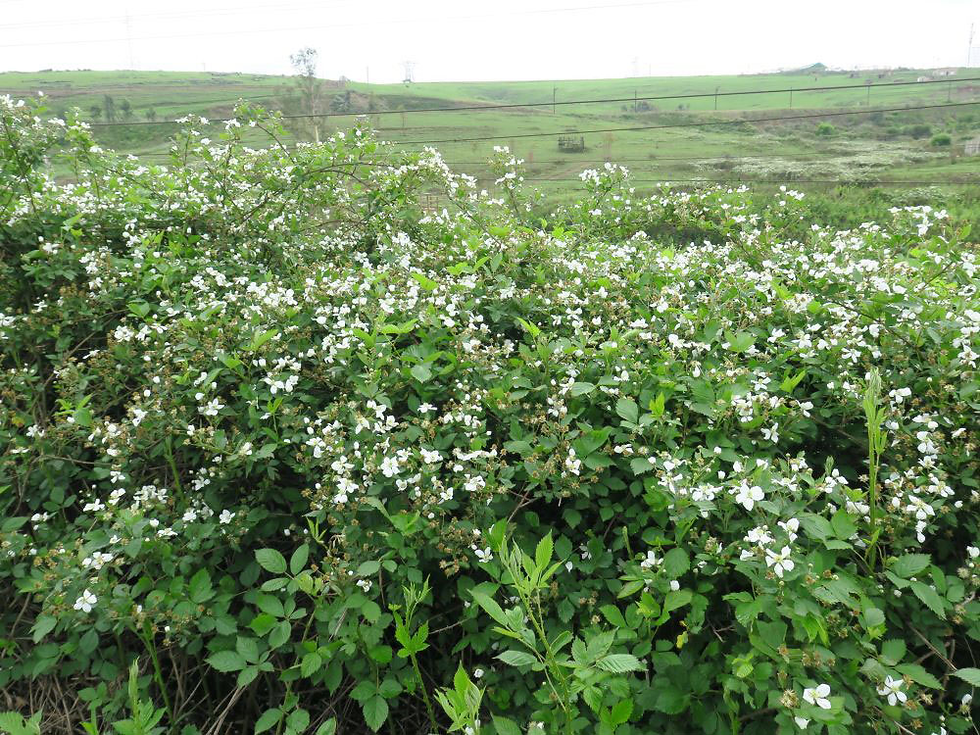
You start with high density and low diversity: one or two woody weeds, fast-growing and short-lived. How do you choose the species? A good starting point is the list of invasives in your area, to be tried out in the field. The very traits people usually complain about — they take over, they smother everything else, they grow where almost nothing else will — are often exactly the ones we want here. The best plants, for me, have been the ones suggested by the roadsides.
The goal isn't the plant itself but four conditions: a closed canopy, deep shade, a litter layer on the soil, and biomass — generated on site as much as possible. It's the hardest phase, technically and psychologically, and the one that, according to Scott, accounts for around 70–80% of the work. Once those conditions are in place, the system tends to hold itself up.
Which species, and in which layer, depends a great deal on climate. Here at OrtoForesta we're trialling (with surprising results) the work done by Amorpha fruticosa, which covers the medium layer below the emergent. It's an approach we've used on a marginal, experimental row, because — as you know — in the market-garden rows we've gone for a different approach, with several layers planted all at once.
It's worth noting that emergent-layer plants — Robinia, eucalyptus or Paulownia — aren't suited to an infestation, because as they shoot up they let too much light through to the lower layers. I'll come back to this in another post, as I've been making some observations lately that I'd like to share.
Phase 2 — Stabilisation
This is early secondary succession. On a pruning cycle of the infestation you plant the true trees — long-lived, over twenty years — and stratification starts to matter more, because by now there are different heights for plants with different light needs. This is where the tree crops belong (citrus, olives, apples) and, in temperate climates, the sturdier support species: Paulownia, mulberry, Robinia, alder on wet soils. The name says the essential: once rooted, this phase is stable, and you can leave it to itself for a couple of years and find it in good health.
Phase 3 — Succession
This one, in a sense — in this approach — isn't designed. You sow a seed bank — ideally every seed of every tree you can get hold of, without too many exclusions — and let it be. It's the birds, perching on the stabilisation trees, that bring the seeds of the more demanding species: their perch is what triggers the phase. From here on the work is almost all management: you prune. The rule Scott often repeats holds — better to have to take out a plant too many than to find yourself wishing it were there.
4. The Time factor
If there's one idea to take home it's perhaps this, and it's cognitive before it's agronomic. "Nothing grows under the acacia, so the acacia is a problem": it's easy to take a snapshot and mistake it for permanent reality. But add time, and that snapshot turns into a process. A stand of acacia isn't an end point: it's often a period of consolidation, building the conditions for the next cohort.
It's something you can check for yourself, and that's the best way to be convinced: just open the soil under the infestation, then on bare ground nearby, and compare colour, moisture, smell, the presence of fungal threads. The difference is often plain to see.
A fair objection remains: "if I don't prune it, it stays like that". In fact, in nature that disturbance came anyway, and it was the large herbivores that brought it. The Mediterranean basin even had lions — the Atlas lion — and therefore herds large enough to sustain them. Many of those large herbivores are gone, and that disturbance, today, largely falls to us. With one advantage: we can choose the moment, make clean cuts, keep the plant from going senescent — things a large herbivore rarely does.
5. Why it works: the pulse of pruning
One of the reasons this approach can generate fertility on site, without importing it, lies in the pruning. As discussed in an earlier post, when you cut a support plant it lets go of part of its roots and releases sugars into the soil; the rhizosphere microbes wake up and, through the mycorrhizal network, the effect reaches the nearby production plants too, which take a boost of growth from it. It's the pulse that syntropic agriculture is built on: density of pioneers and pruning at the right time — better still just before flowering — are often enough to create fertility without having to bring it in from outside.
6. How to begin (and what to expect)
The practical principles, in the end, are few.
According to Scott, there are no recipes. Wild plants remain among the best consultants we have, and no list is ever truly definitive. Better to observe, before ordering seeds from the other side of the world.
One phase at a time. It's worth focusing on the infestation, which is the real hurdle; the rest comes later, when you know more. You grow along with the system: you start simple and become gradually more complex, like the woodland you're creating.
Density before diversity. Diversity comes on its own, with time; density, at the start, is the part that's down to us.
Patience. The most obvious limit of successional accumulation is the lack of instant gratification: the fruit comes later. But once the first years are past, it tends to make up the lag — and often to overtake "plant all at once" on several fronts.
Finally, it's worth recalling an observation of Scott's that I share entirely: many of the objections to this approach — the roots that would supposedly compete, the shade that would be too much — come more from fear than from experience. Often it's worth flipping the perspective: plenty of roots mean nitrogen, structure, life in the soil; plenty of shade means cool soil and biomass to prune. The problem, as he puts it, is nearly always up here: in our heads.
Thanks to Scott Hall for the generosity with which he shares his work, and to all the pioneers who take the trouble to try things that most farmers can't even be bothered to observe. On their shoulders we go on seeing a little further.


Comments