NGTs and GMOs - what happens?

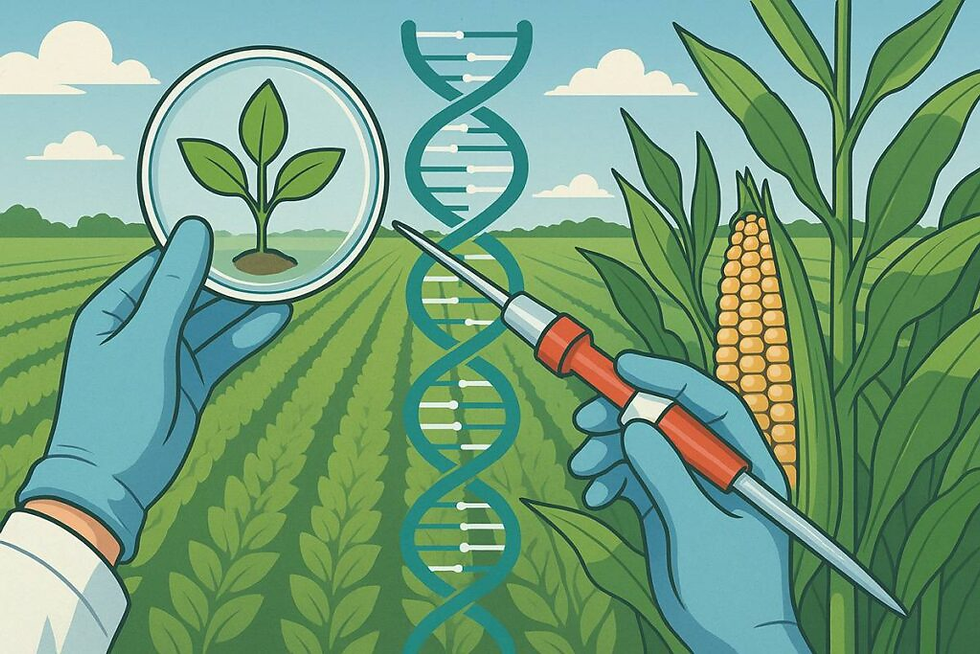
On 17 June 2026 the European Parliament gave final approval, at second reading (431 to 201, with 29 abstentions), to the regulation on New Genomic Techniques — NGTs, or in Italy TEA, tecniche di evoluzione assistita, “assisted evolution”. It splits NGT plants in two: NGT-1, judged equivalent to what ordinary breeding could have produced and now treated more or less like any other crop; and NGT-2, which stays inside the existing GMO framework. The shift is one of philosophy — from regulating the method by which a plant was made to regulating the characteristics of the plant itself. The rules apply from about 2028.
Several amendments were tabled and voted down — to ban patents on NGTs, to shield farmers from liability for accidental contamination, and to require a public register of NGT-1 plants with ways to detect them. The detail that matters most to a shopper, though, is labelling: NGT-1 food will carry no GMO label, only the seed will. The tomato in the crate won’t tell you it was edited.
Whenever something like this comes up, I hear people take very strong positions — often understandable ones, but emotional, and almost always cast the same way: what I think is sensible and good, and the opposite is reckless, dangerous, a disaster. On a question this tangled, ethically and biologically, that isn’t a frame I trust. So I’ll try the duller route instead: set out what happened, then the case for and the case against as fairly as I can, and only at the end what I make of it — with no pretence that my view is especially enlightened. My customers and fellow growers can read it and know where I stand, and I hope it starts a conversation. All in all, I don’t think this will prove as catastrophic, or as decisive, as either side is making it sound.
What NGTs are, and aren’t they just GMOs?
In plain terms, NGTs make a small, deliberate change to a plant’s own DNA. The best known is CRISPR — a kind of “find-and-replace” for genes: you go to one spot in the genome and switch a gene off, or swap a few of its “letters”. Same plant, one line of the manual rewritten.
This does sound like GMOs, and that’s half right. The classic GMO, a transgenic, inserts a gene from another species — the textbook case is a bacterial gene put into maize. Most NGT edits don’t: they rework the plant’s own genes and add no foreign DNA, so the result could in principle have arisen on its own. That claimed equivalence is what earns NGT-1 its lighter treatment, and it is contested: “could have happened naturally” is not “did”, edits can have unintended effects, and a plant can be new without a foreign gene.
A spectrum, not a clean break
I view this as the last step in a long line of breeding technologies — a spectrum from indirect to ever more direct, not a clean split between “natural” and “engineered”. Worth setting out, because the GMO / not-GMO line follows it only loosely.
Selection and crossing — choosing and mating plants for millennia. The “natural” baseline.
F1 hybrids — crosses for hybrid vigour, often using cytoplasmic male sterility, itself sometimes made in the lab by protoplast fusion across species. Counted as conventional, not GMO (though strict organic standards shun the fusion route).
Mutation breeding — since the 1920s, seeds hit with gamma rays or chemical mutagens to force random mutations, then selected. Thousands of varieties, many of them organic, come from it — crude, untargeted, yet GMO-exempt.
Induced polyploidy — colchicine to double a plant’s chromosomes (seedless watermelon, many ornamentals).
Marker-assisted selection — DNA markers to guide ordinary breeding; no modification, just better choosing.
Transgenesis — the classic GMO: foreign genes inserted (Bt, herbicide tolerance).
Cisgenesis — genes from the same species, or one it could cross with anyway.
RNAi — silencing a gene rather than editing it.
Gene editing / NGTs — targeted edits, often with no foreign DNA.
If we line them up, the point is plain: the rules have never tracked the biology cleanly. We blasted seeds with gamma rays for decades and shelved the results in ordinary catalogues, and the organic aisle, with no fuss and no public debate. Transgenic GMOs got a long, bitter, continent-wide fight. CRISPR and the NGTs are getting a version of that fight again — only quieter, and more carefully managed.
The reactions
The vote split the field as expected. Coldiretti and Filiera Italia hailed “a historic turn”, presenting TEA as a home-grown innovation with “nothing to do with the old transgenic GMOs”; the seed firms, KWS and Euroseeds among them, were glad of the legal certainty. On the other side, Via Campesina denounced “the deregulation of GMO-NGT plants”, and FederBio, other organic bodies and a broad mix of small farmers and consumers protested what they read as a dangerous, opaque step.
The case for NGTs
Let’s start with why these techniques exist, because the case is real. The pull is precision and speed: where old mutation breeding scattered random changes and waited, an edit aims at one known gene and arrives years sooner than crossing. With it comes much of what breeders have long wanted — resistance to a pest or a fungus, and so fewer sprays; tolerance to drought, heat or salt; lower toxins, better nutrition, longer shelf life. These aren’t only promises: powdery-mildew-resistant wheat, wheat that bakes with less acrylamide, disease-resistant rice are already in trials. People who are in favour of this technique call it describe it as useful, incremental plant breeding, faster and more targeted than before. And since no foreign DNA need be involved, supporters argue the product is essentially conventional; since editing is cheap, their hope is that public labs and small breeders use it too.
The concerns
There are real objections too, and they deserve the same hearing. First, precaution: off-target edits, knock-on effects, and the open question of whether an edited plant is truly “equivalent” to one that arose by itself. Second, the model of farming — that NGTs may entrench input-hungry monocultures rather than diverse, low-input systems. But the three that drew the sharpest fight in Parliament were transparency, patents and farmer protection, each, tellingly, a rejected amendment.
Transparency. NGT-1 food carries no label (only seed does), and many edits can’t be told from natural mutations in the lab, so they can’t easily be detected either. The amendment for a public register and detection methods was voted down. Supporters answer that, under the equivalence principle, there is nothing meaningful to flag.
Patents. Edited traits can be patented, and the move to ban NGT patents was rejected. Critics fear a seed market concentrated in a few firms, and farmers dragged into disputes when a patented trait drifts into their fields; the amendment to protect them was rejected too. In fact, the issue is even more delicate: because the same genome sequence could potentially arise naturally, a farmer could get sued by the owner of a patent on that or a similar sequence, even though there was no drift and no foul play. It must be noted though, that proprietary varieties predate NGTs — Salanova, Pink Lady, and many other cultivars.
Centralisation. Some critics have seen a design that aims to empower seed corporations with lighter rules for them, patents that are hard to detect, contamination costs landing on the organic farmer who never wanted them. Opt-outs exist, but a country can hardly police what it cannot detect.
Where I stand
Two things weigh on me more than the rest: transparency and centralisation.
The lack of transparency is one of the most problematic points. A label that disappears for the eater, on a product that by design can’t be detected, takes away the ability to know what you’re eating, and to choose otherwise. Parliament could have kept that ability, with a register and detection methods, and chose not to. That, for me, is the crux: not the biology of the edit, but the right to know about it.
Fortunately though, where the law won’t inform, we still can: we can remind customers that organic will stay NGT-free, and even on non-certified farms, we can say plainly that we grow NGT-free; then people can decide with their money and their feet. Is it ideal? No, but it’s something we can do now.
I would treat customers and all citizens as intelligent adults, giving them the freedom to choose. I would also put more on the label, not less — not only the genetics, but how a thing was grown, how mechanised the work was, what was sprayed and when – but that’s a story for another day.
Centralisation is an even larger worry, and it is older than NGTs. If we follow the threads (which is, as usual, to follow the money — as they say), they all point in the same direction: more of the food system, its seeds and its rules, in fewer and larger hands. Power keeps drawing everything toward the middle — food, medicine, the lot — until a few very large corporations can more or less do as they like. And I wouldn’t feel much easier if it were the State holding the strings instead. With food, as with most things, I don’t believe centralisation is a wise road. Ecological processes say as much, if we let them teach us: resilience lives in diversity, complexity, redundancy and localism — never in a large-scale, simply structured hierarchy of control.
This tendency towards centralised control, however, manifests itself in many more issues than just NGTs, and I find it quite perplexing that some critics only rise up when it comes to genetics. If we study the history and science of agriculture, it is strikingly evident that the mechanisation of agriculture (and its dependence on fossil fuels), the widespread use of plastic, the introduction of modern F1 hybrids and many of the other genetic techniques listed above, the robotisation of our fields, and many other controversial aspects of modern agriculture are all part of the same process. A process that leads to fewer and fewer growers setting foot on the soil, and fewer growers per hectare. This, as I wrote in the past, has very little to do with efficiency and feeding the masses (because it fails at doing so on all fronts), and it has everything to do with increasing centralised control.
However, as with plastic or tractor use, we all have our positions on these matters, and most of them make sense to me, even where I end up at odds with most of my colleagues. What I would like is to go on discussing them in the open — laying out the facts, the pros and cons, the opinions — and to respect the people who disagree with me.
I would like growers and customers to discuss what is the future they want to work towards. And make actionable plans. Do we want the agriculture of the future to be run by university professors remote-controlling a workforce of AI-robots? Do we want the food of the future to be handed down in capsules sold by a few corporations, containing all the nutrients we need (conveniently measured by sensors in our own bodies and houses)? Because, this is the direction we are going, and NGTs are only a small part of this overall direction.
Or perhaps in an ideal world communities participate in food production actively, there are 10 or more people per hectare: growing, harvesting, processing, preserving, sharing.
I don’t think one vision is objectively better than the other, but I wish we could simply get to freely choose how we eat, how we grow, how we buy, how we live — every option open on the table, and nobody trying to force theirs while demonising all the rest.


Comments