November Newsletter


Dear friends,
I don’t know about you, but I turned around for a moment and it was already November.
I walk among the trees of our agroforestry rows and enjoy this warm, melancholic light.
For those of us who do this work, or who work outdoors in general, the shortening days bring a kind of relief, the feeling of a crossing completed. After pruning the support plants in the past months, and sowing the cover crops and the last quick crops, all that is left in the market garden is to harvest the vegetables planted in summer and to organise the biomass they leave behind. It is the perfect time to spread compost on the beds as they empty, and perhaps to sow broad beans and garlic in them, marking what is, to all intents and purposes, the start of the growing season that will peak next summer.
For me this is always a magical moment. It brings back the gestures of more than ten years ago, when I was first improvising myself as a grower. Out of this mix of emotions comes the awareness of being on a journey: between the seasons as they follow one another, between farming methods and paradigms, between different trades and generations.
These days, on a thousand different fronts, our small world, seen through a petit-bourgeois lens, seems to be on fire yet again, between wars, protests, incompetent governments and all-powerful multinationals. The social and cultural mechanics we had grown used to are threatened by ever more violent shocks. Farmers in the streets in the south, students in the squares in the north, the cold war between the United States and China fought with AI, the many wars around the world and everything that revolves around them are only the latest flashes of a relentless storm whose roots go a long way back.
As an old, hardened anarchist, I stop for a moment to watch, and I remind myself that crises, in their loudest manifestations, are almost always the expression of a dying system thrashing about in the grip of the new that is coming. This evolution unfolds in many jerks and disorderly tremors: of society and its cumbersome, obsolete institutions, of the self-referential and somewhat artificial culture of our West, of ecosystems that invade and are invaded by so-called alien species, of social classes becoming aware that they exist and that they are changing, of a decaying landscape. Each of us, with our own inner and outer struggles, is crossed by this process and expresses some aspects of it. As students of ecology, we know these jolts could turn out to be the first clumsy, disjointed movements of a chrysalis realising that its metamorphosis is almost complete. What butterfly will emerge from all this turmoil remains to be seen. In the meantime I invite myself to look at these processes holistically, widening my gaze as far as I can, beyond the shape our individual perceptions and undertakings take.
To quote a visionary with whom I had the privilege of sharing a short stretch of the road: “Inside me live, with the very same life as mine, microorganisms that don’t know they belong to my body. And I, which body do I belong to?”
Alongside all this, and amid the churning of these tectonic movements, my own tiny life as a farming minstrel has also been on the road this past month. I was in Marche, with Yuri and Isabella at Rasoterra, and in Puglia, with Nico and Gaia at Casa Centofoglie. What I felt, among the many people I met and talked with, was enthusiasm, an explosive energy, a desire to create, to build, to regenerate the fabric of our lives, above all on the social side. What the many people who come to my courses share, and they generously share their views, their experiments and their paths, is not so much the wish to farm differently as the wish to build another world, resting on completely different foundations. A world in which suggesting that the horse is more efficient than the tractor, mutual aid more than market dynamics, and CSA more than farmers’ markets is not heresy but common sense. A world in which the ecosystem is the unit on which everything rests, not a scientific curiosity.
I have written about this, and about the many forms this desire to build takes, in different ways and from different angles, in much of what you will find below in this November newsletter.
There are some reflections on selling and on customers, on sharing between colleagues, and on the value of being a bit more hobbyist and a bit less professional in farming. There is a systematic introduction to syntropic agriculture, in two parts. There is the story of a meeting that inspired and shook me, with an exceptional seed keeper. And there are the usual columns. Enjoy the read.

Sharing or monetising
To prepare the regenerative market gardening course I taught a few weeks ago at Rasoterra, Yuri and Isabella’s farm in the province of Fermo, I had asked several colleagues to send me photos and videos of their work: bed preparation, transplanting, the sequence of operations before and after, and above all soil management after harvest, from cultivation to mulching, fertilisation and irrigation. I needed this material as a basis for a theme I consider central: how to generalise a technique without copying it.
The willingness, speed and generosity of the great majority of the colleagues I have the privilege of working with never stop surprising me, and I am deeply grateful for it. Sometimes, though, something less pleasant comes up. On this occasion one colleague refused to send me the material, arguing that it represented his work, that he runs paid courses himself and that, since I would be using it in an activity I am paid for, it would not be fair to hand it over for free.
Something similar had already happened with another farmer I had invited onto the Pionieri podcast.
Read the post · Watch the videos (part two) (in Italian)

Farmers, professionals, hobbyists
In farming, as in many other fields, there is a tendency to sideline, and sometimes to ridicule, those who do this work without earning a living from it. They get called amateurs, or hobbyists, a label I find unfortunate: these are people who grow their own food, who seek self-sufficiency, who feed their families. And they are often treated as a separate category, inferior to those who farm for a living.
Yet these are often precisely the people who can afford to take the most risks. Those who farm for a living have to make ends meet at the end of the month, and so they are forced to choose techniques partly on the basis of efficiency and profitability. Those who grow for themselves can invest more time and resources, make many more mistakes and, for that very reason, try out ideas that would be off-limits to a professional. Many of them also work with a fully professional attitude without earning anything from it, bringing into the field the precision they learned in another trade, in an engineering office or an accountancy firm, and they have a lot to teach those of us who grow for a living. Free from the constraints of business efficiency and from the need to accumulate capital to reinvest, they can run experiments from which all of us can learn something we would not otherwise learn.
Read the post · Watch the video (in Italian)

The customer does not exist
In the way I see this trade, selling comes second. Our work is to collaborate with the ecosystem to produce food, and that food naturally has to reach someone who will eat it; but whether it gets there through an exchange of money is only one of the possible forms. In the past I was lucky enough to work in places where food was grown and shared with no money changing hands, and since then I have seen both my work as a grower and my work as an educator as a chance to blur the line between customer and producer.
Read the post · Watch the video (in Italian)

An introduction to syntropic agriculture
For about five years I have been studying syntropic agroforestry closely and hungrily. I have had the privilege of visiting farms, interviewing designers and attending courses. Beyond its productive claims and the caricature it is often painted as, in my view syntropic agriculture has the great merit of approaching the question of farming from a perspective that is neither anthropocentric nor utilitarian, and that I consider crucial for the future of our species.
What is the bio-ecological role of humans in the ecosystem they belong to? Can farming be brought closer to the processes that, in the wild, would see an animal like Homo sapiens as part of a complex, dynamic and well-tuned ecological machine?
That this approach is seen as revolutionary in world agriculture is a measure of how far we have drifted, not only from our role in the ecosystem, but also from the more integrated relationship with the land that indigenous peoples and our own ancestors had.
That is why I have written a lot on this subject. Below you will find the first two parts, updated, of my Introduction to syntropic agriculture; more will follow.
Meeting Angelo Giordano
During the course I taught at Casa Centofoglie, in Puglia, I met one of the most knowledgeable and best-known keepers of seeds and heritage varieties in Italy: Angelo Giordano. Angelo told me about, and showed me on his phone, a flood of fascinating varieties from all over the world: green Thai aubergines, very sweet, productive and soft; ribbed determinate tomatoes with thin skins and excellent flavour; zebra-striped beans; watermelons of which you eat only the white part, creamy and with a peculiar taste; and many more. Of all of them, the one that struck me was a black and white bean, beautiful and with a very particular story.

L’incontro con Angelo Giordano
In occasione del corso che ho tenuto a Casa Centofoglie, in Puglia, ho conosciuto uno dei custodi di semi e varietà antiche più competenti e più conosciuti d’Italia: Angelo Giordano. Angelo mi ha raccontato, e mostrato sul suo telefono, una marea di varietà interessantissime provenienti da tutto il mondo: melanzane verdi thailandesi, dolcissime, molto produttive e morbide; pomodori determinati costoluti, dalla buccia sottile e dall’ottimo sapore; fagioli zebrati; angurie di cui si mangia soltanto la parte bianca, cremosa e dal gusto particolare; e molte altre ancora. Tra tutte mi ha colpito un fagiolo bianco e nero, bellissimo e dalla storia molto particolare.

A look elsewhere: Jesse Frost and living pathways
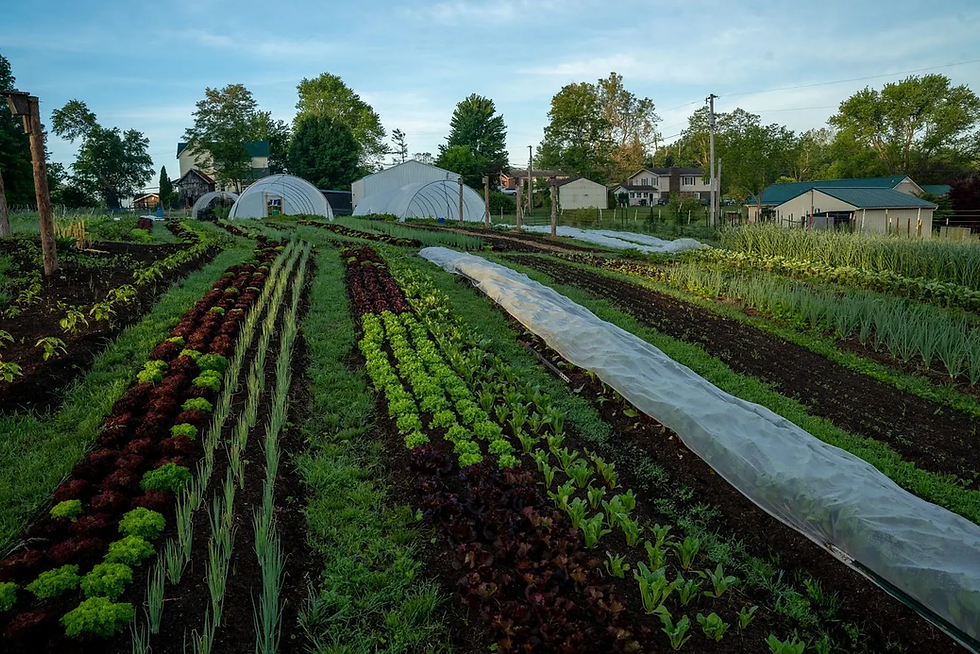
This month I want to point you to someone who had a big influence on my training as a grower: Jesse Frost of No-Till Growers. In particular, I suggest a series of videos in which he talks about his experience with living (grassed) pathways in a biointensive no-till market garden. The most common approach in this kind of system is pathways mulched with woodchip, or bare and hoed. Jesse, pushed by the need to reduce the erosion caused by Kentucky’s heavy winter rains, decided to experiment systematically with grassing the pathways between the beds. Over the years he has shared the joys and the pains of that choice.
Courses and events
Over the coming months I will be at a number of events and courses, in both the south and the north of Italy. All of them are in Italian.
On 12 December I will take part in the RizoFest of the Collettivo Rizosfera, in Udine, where I will speak for just under an hour about agroforestry. There will be other talks, all very interesting, by Antonio Bassan, Massimo Raimondi, Enrico Battistello, Isabella Paganini and Antonio Scioscia. The event is free, but you need to register: registration and poster.
On 15 and 16 January I will be back at Inferno Food Forest for a course I have called Soil, plant, agroforest: nutrition, microbiome and systemic approaches to regenerating the agroecosystem, where I will discuss the principles of soil fertility and plant health, showing the pros and cons of different approaches: from materials (soil amendments, mulch, biostimulant treatments) to processes (no-till, cover crops, agroforestry). Programme · registration: contradainferno@gmail.com
On 30 and 31 January I will be in Messina for a hands-on course in regenerative agroforestry, where we will plant a successional agroforestry orchard in a Mediterranean climate, in a magical place overlooking the whole Strait of Messina. Registration: farisusu.project@gmail.com
On 13 and 14 February, again with the Collettivo Rizosfera, I will teach a course in Valli del Pasubio (Vicenza) on nutri-protection and crop management of the main market garden vegetables: programme and registration.

On the margins
This newsletter’s column: a quote, a person, a book, often outside the furrow of farming, because it is on the margins that the most interesting ideas come up.
The quote: Michael Pollan
“Cooking, I found, gives us the opportunity, so rare in modern life, to work directly in our own support, and in the support of the people we feed. If this is not”making a living,” I don’t know what is. In the calculus of economics, doing so may not always be the most efficient use of an amateur cook’s time, but in the calculus of human emotion, it is beautiful even so. For is there any practice less selfish, any labor less alienated, any time less wasted, than preparing something delicious and nourishing for people you love?”
“Well, in a world where so few of us are obliged to cook at all anymore, to choose to do so is to lodge a protest against specialization—against the total rationalization of life. Against the infiltration of commercial interests into every last cranny of our lives. To cook for the pleasure of it, to devote a portion of our leisure to it, is to declare our independence from the corporations seeking to organize our every waking moment into yet another occasion for consumption. (Come to think of it, our nonwaking moments as well: Ambien, anyone?) It is to reject the debilitating notion that, at least while we’re at home, production is work best done by someone else, and the only legitimate form of leisure is consumption. This dependence marketers call”freedom.”” (Michael Pollan, Cooked)
The person: Joy Larkcom
Joy Larkcom, the English writer and grower, is an icon of English vegetable growing, amateur and otherwise. In the 1970s she set off with her family on a long journey across Europe to see how vegetables were grown outside the UK, and from that trip and her later travels in Asia she brought back varieties, techniques and an idea of the vegetable garden far more varied than anything England knew. She was the first to promote pak choi, Chinese cabbage, mustards and various mizunas in Europe.
Of her books I recommend The Salad Garden and Oriental Vegetables, two very readable manuals that helped me a great deal when I started growing mixed salad leaves for sale in England.

The book: Free to Learn
In Free to Learn (2013) Peter Gray, a developmental psychologist at Boston College, makes a simple and radical case: children are biologically designed to learn by themselves, through free play and exploration, and school as we know it, with its curricula, tests and adults deciding what to learn and when, tends to switch off exactly those instincts. Gray brings together studies of hunter-gatherer societies, where learning happens almost entirely through play and imitation, the experience of democratic schools such as the Sudbury Valley School, and sociological data on childhood over the last few decades. The most illuminating thread, for me, is the close link between free play among children of different ages, with no interference from adults, and low rates of depression and anxiety in young people. In today’s society, where free play is very rare if not entirely absent, we are seeing exactly that: a rise in psychological problems among teenagers and beyond.
The book is about children, but it concerns all of us. It doesn’t take long to realise that we only truly learn what we are free to explore. And yet many people still believe that if we didn’t force people (children and adults) to learn what someone (who?) considers important, everyone would end up ignorant and useless (for what?). A book I warmly recommend, because it makes you think and it inspires freedom and beauty.

And with that I’ll say goodbye and see you next month. Let me know, with a comment, a message or a reply to this email, what you think of any of the things you have read in this newsletter, or of all of them. Tell me too how you read it, all in one go or in several sittings, and whether you would prefer it shorter or longer.
Speak soon,
Dario


Comments